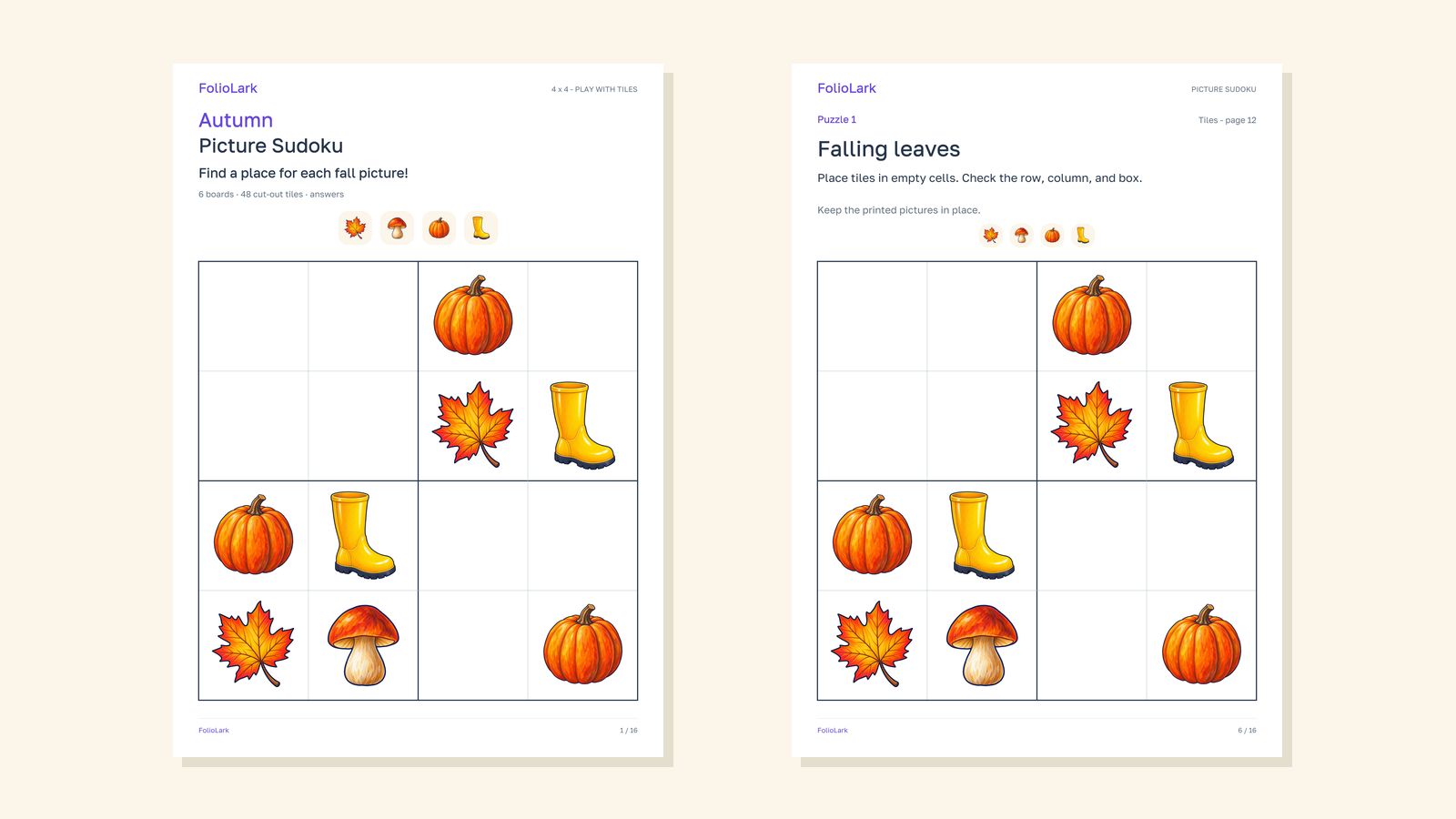
Autumn Picture Sudoku
Six picture boards, 48 full-cell cut-out tiles, visual rules, a separate example, first hints, and answers. A sixteen-page color PDF in A4 and US Letter.
Free download. No subscription required.
Free for personal use and activities with children. Do not resell or redistribute the files.
Find a place for each fall picture! An adult cuts out the tiles, then you place them in the empty cells. A leaf, mushroom, pumpkin, and rain boot belong once in every row, column, and little box.
Six boards · 48 cut-out tiles · first hints and answers

210 × 297 mm · 16 pages · Color

8.5 × 11 in · 16 pages · Color
Place pictures, one cell at a time
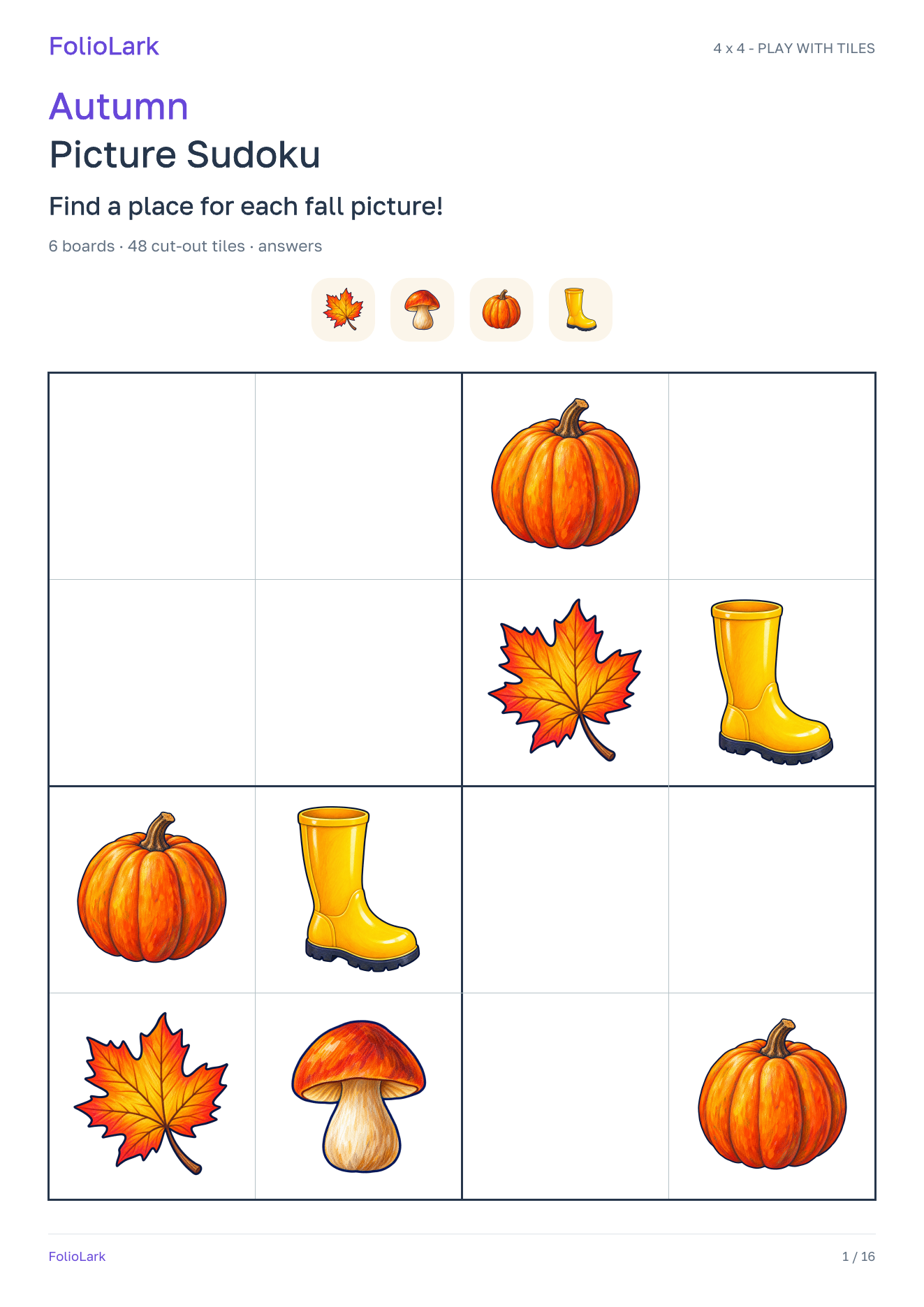
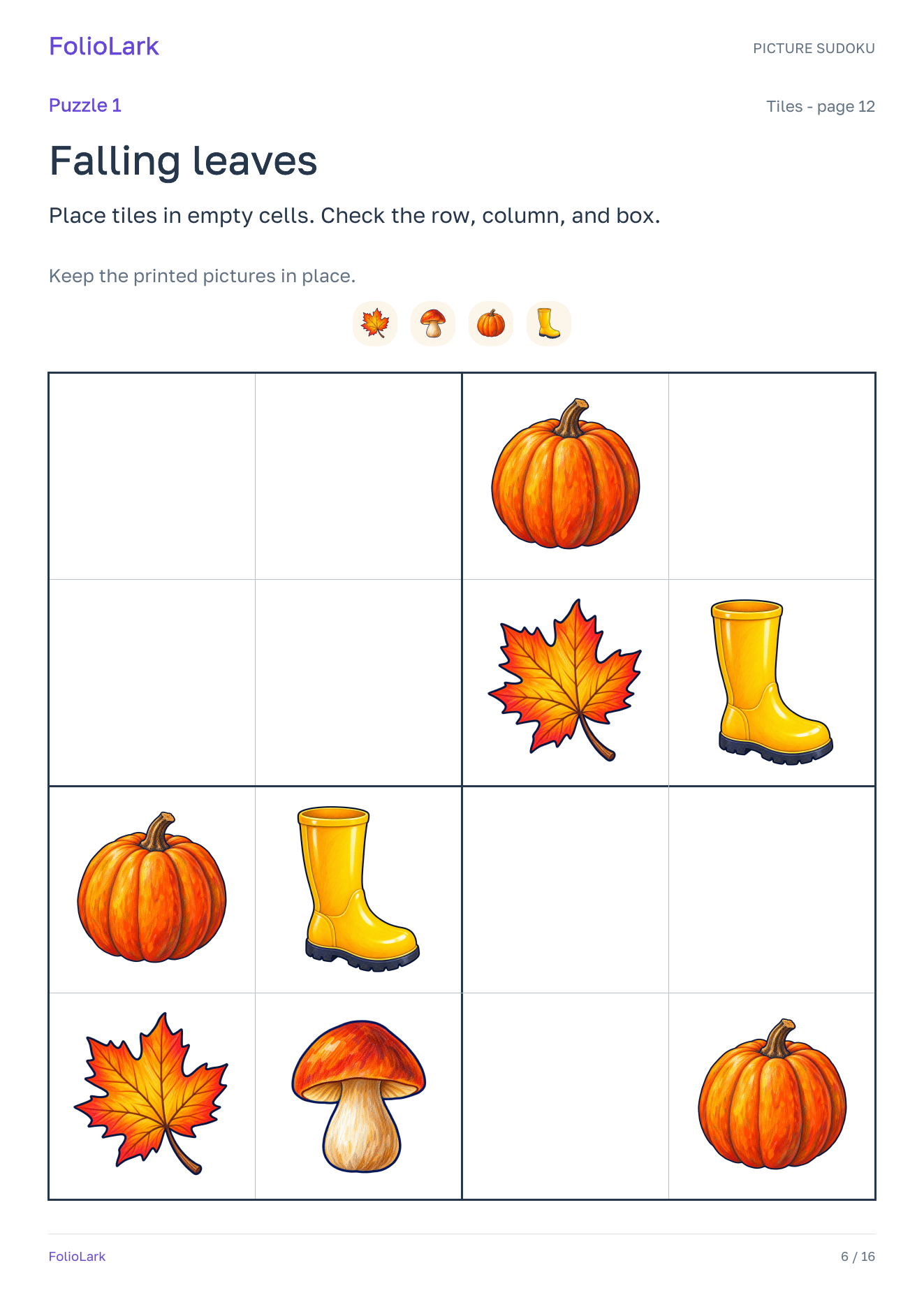
Each 4 x 4 board begins with eight printed pictures and eight empty cells. Use the eight tiles labeled for that puzzle to fill the spaces. Leave the pictures already printed on the board where they are.
The practice grid measures 188 × 188 mm, with 47 × 47 mm cells. Each cut-out tile is also 47 × 47 mm, so it covers one full cell. Both paper versions keep these sizes when printed at 100% / Actual Size.
What's inside
- A sixteen-page color PDF in each paper size: A4 and US Letter.
- Visual rules for a row, column, and 2 x 2 box, plus grown-up setup notes.
- One separate example and its first three steps.
- Six different practice boards, one per page.
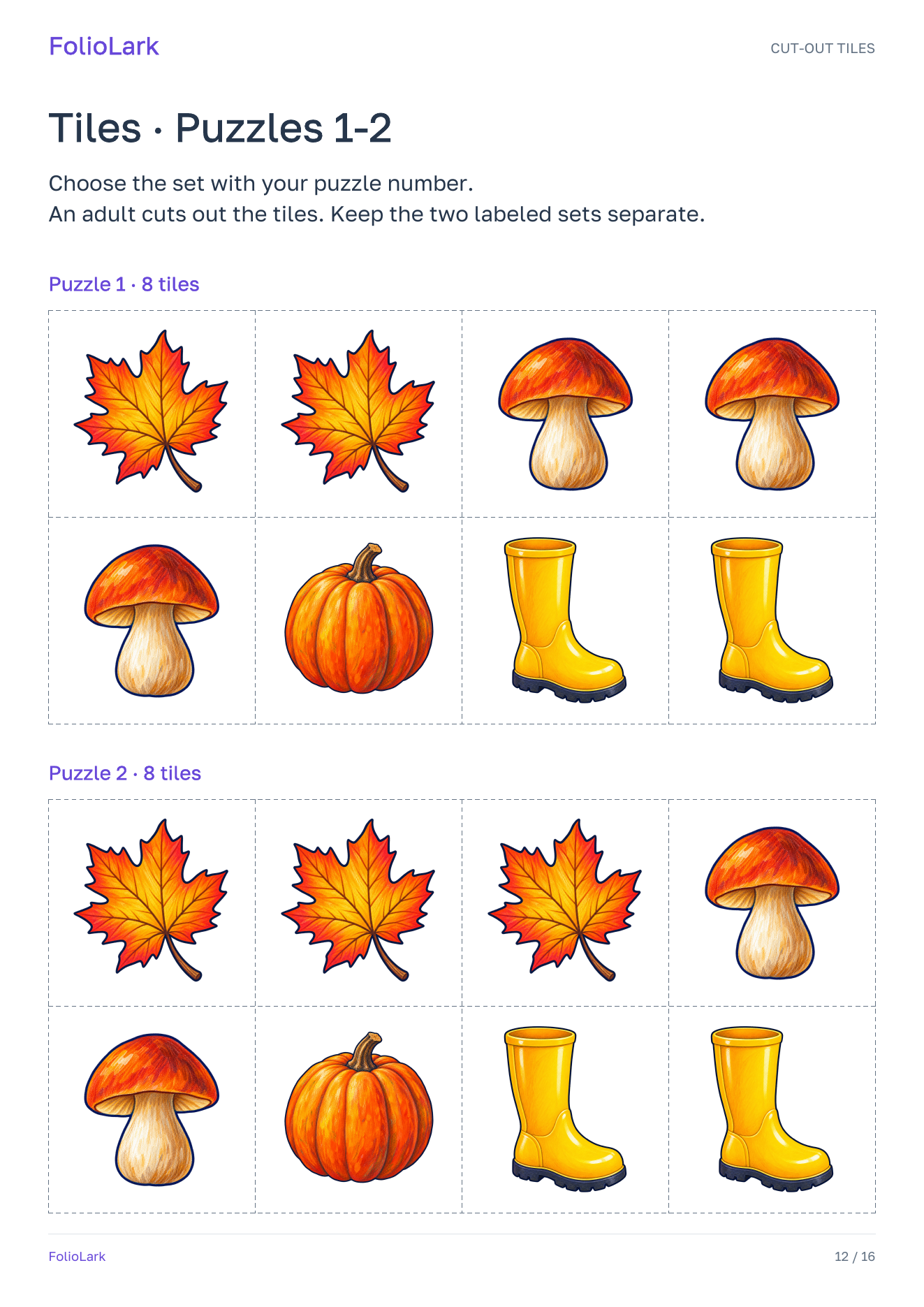
- Three cut-out sheets with 48 tiles in six labeled sets of eight.
- Complete answers and first hints for every board, plus the full example answer.
The cover previews Puzzle 1. That repeated preview is not another practice board. The example is separate from the six boards and is shown on the pages; it does not need an extra tile set.
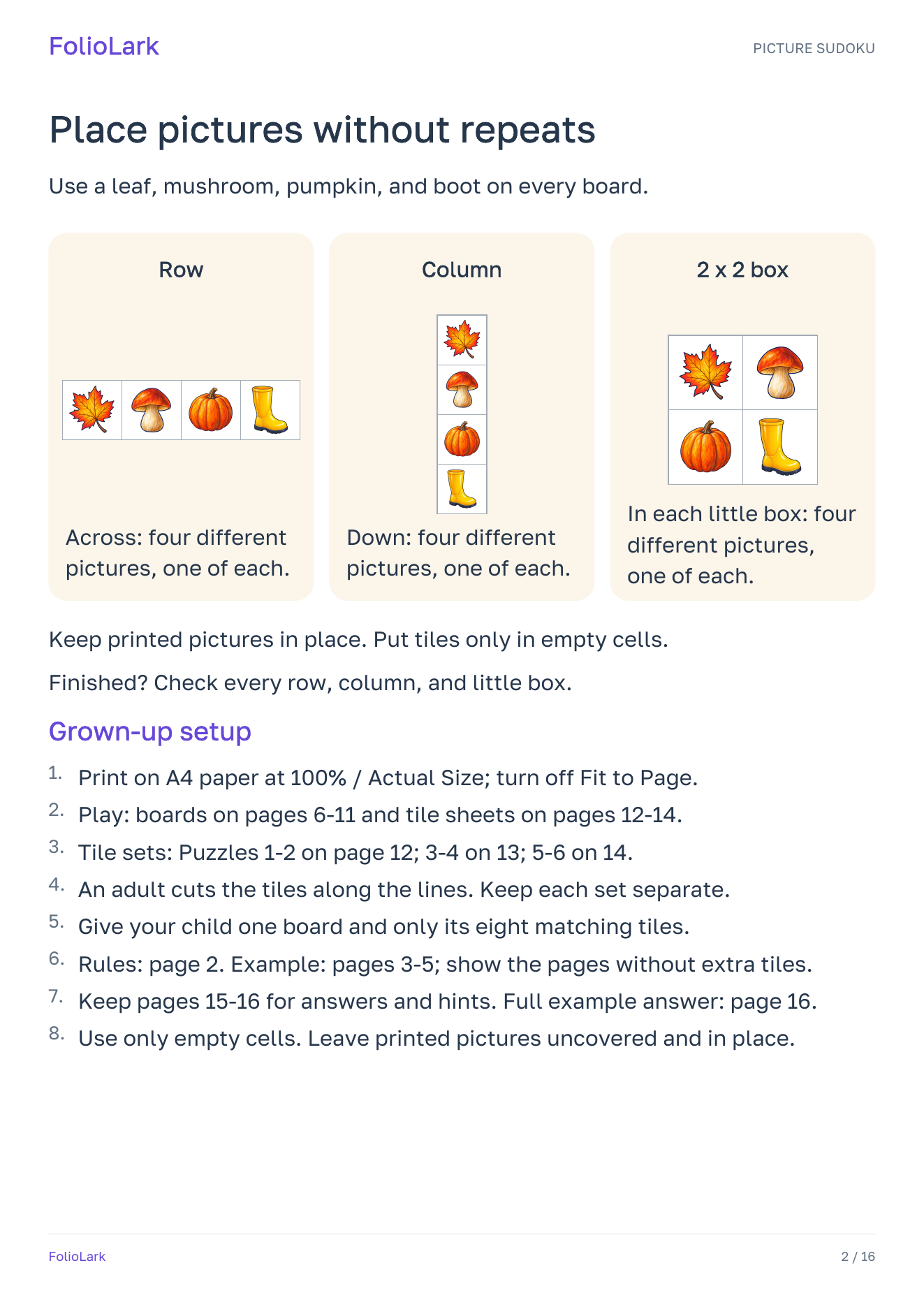
Four pictures, three checks
Use the leaf, mushroom, pumpkin, and boot once in each area:
- Look across every row: four different pictures, one of each.
- Look down every column: four different pictures, one of each.
- Look inside every little 2 x 2 box: four different pictures, one of each.
Place tiles only in empty cells. Keep the printed pictures uncovered and in place. When the board is full, check every row, column, and box.
Match a board with its tile set
An adult cuts the tiles along the dashed lines. Keep all six sets separate, and choose the set with the same puzzle number as the board.
- Puzzle 1: board page 6; tile sheet page 12.
- Puzzle 2: board page 7; tile sheet page 12.
- Puzzle 3: board page 8; tile sheet page 13.
- Puzzle 4: board page 9; tile sheet page 13.
- Puzzle 5: board page 10; tile sheet page 14.
- Puzzle 6: board page 11; tile sheet page 14.
Each set has the exact eight pictures needed for its board. The amounts differ between sets, so keep them labeled rather than mixing them together.
Look at the example together
The example starts on page 3. Its first target is row 1, cell 2. The row allows only a leaf; the column allows a leaf, mushroom, or boot; the box allows a leaf or mushroom. Only the leaf fits all three.
The next step places a mushroom in row 2, cell 1. The third places a leaf in row 2, cell 4. Pages 4-5 show these first three steps. Other cells remain empty; the full example answer is on page 16. Show the example on the pages rather than taking tiles from a practice set.
Print and prepare
Choose A4 for A4 paper or US Letter for US Letter paper. Print at 100% / Actual Size, with Fit to Page turned off.
For all six boards and their tiles, print pages 6-14. Rules and setup are on page 2; the separate example and its first three steps are on pages 3-5. Keep pages 15-16 aside or on screen for the answers and first hints.
Give your child one board and only its eight matching tiles. An adult does the cutting; the player places the prepared tiles.
Questions before you print
Do we write numbers? No. The player grids use pictures. Place the prepared tiles into the empty cells.
Who cuts out the tiles? An adult. The player receives the eight tiles labeled for the chosen puzzle.
Can we mix all the tiles together? Keep the six sets separate. Each puzzle needs its own eight tiles, and the picture counts differ between sets.
Where are the hints and answers? Pages 15-16. Match the puzzle number to the answer and first hint. The full separate-example answer is on page 16.
Does the example need a tile set? No. Page 3 shows the original example; pages 4-5 show its first three steps. Look through those pages with a grown-up.
Should tiles cover the printed pictures? No. Put tiles only in empty cells. Do not cover or move the pictures already printed on the board.
How large are the tiles? Each tile is 47 × 47 mm, matching a full practice cell. Choose the correct paper version and print at 100% / Actual Size.
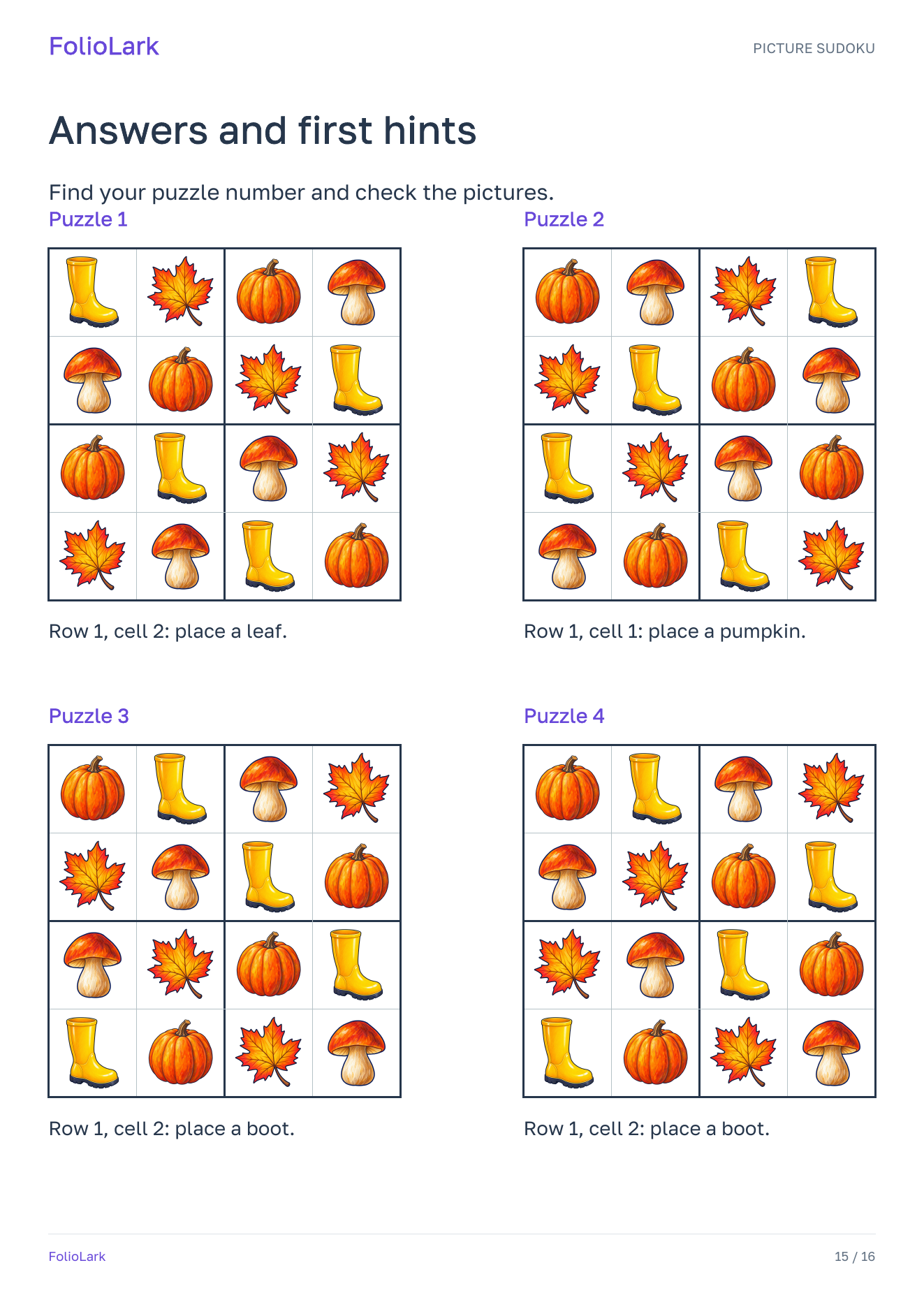
Answer preview: Puzzles 1-4
Cut-out tile sheet: Puzzles 1-2